
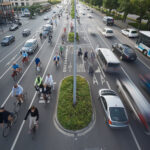
Traffic in Italian Cities: What the Isfort Data Tell Us
17 September 2026
The smart city is no longer simply a city equipped with digital services. It is an urban ecosystem in which data, infrastructure, mobility, traffic management, public services and artificial intelligence interact to make cities more efficient and improve the everyday experience of citizens and businesses.
This is the picture emerging from the Intelligent Cities Index 2026 by Boston Consulting Group (BCG), which assesses 61 cities across 39 countries. London tops the ranking with a score of 85 out of 100, followed by Dubai, New York, Washington and Amsterdam, all scoring 80.
For Italy, the picture is more cautious. Rome and Milan rank 40th and 41st respectively, both with 61 points, placing them in the Emerging category. The two cities therefore remain some distance from the level of maturity achieved by cities classified as Leading or Accelerating, although both are pursuing a broader process of digital transformation.
A smart city is an integrated urban system
One of the key messages of the BCG study is that a smart city cannot be defined simply by the amount of technology it uses. The real challenge is to connect different urban systems and use technology to make them work together more efficiently.
This includes smart mobility, covering connected public transport, dynamic travel management, intelligent parking systems and real-time information for commuters and travelers.
Equally important is intelligent traffic management. Sensors, digital platforms, data analytics and AI can be used to monitor traffic flows, identify congestion and adjust mobility systems according to real-time conditions. The objective is not simply to reduce traffic jams, but to improve the efficiency of the entire urban mobility network.
The same approach applies to smart infrastructure. Energy networks, public lighting, buildings, water systems and other urban assets can be monitored through sensors and digital platforms. This makes it possible to identify problems earlier, optimize resources and plan maintenance more effectively.
Five dimensions for measuring an intelligent city
The BCG index evaluates several aspects of urban and technological development. These include outcomes for citizens, the quality of a city’s strategy, adoption of digital tools, governance and collaboration between the public and private sectors.
The analysis also considers key enablers such as data, infrastructure, talent and capital. These elements provide the foundation that allows cities to move beyond individual digital projects and build genuinely connected urban systems.
The ranking also highlights different approaches among leading cities. London stands out for its results for citizens, Madrid for strategy, Dubai for adoption, New York for governance and Amsterdam for its enabling factors.
Rome and Milan: from digitalisation to intelligent urban management
For Rome, the report highlights the strategy dimension, which assesses the scope and level of detail of official planning related to digital technologies and artificial intelligence.
Its overall position, however, remains within the Emerging category. Milan receives the same overall score of 61 points and ranks 41st.
The gap between the Italian cities and those at the top of the index is therefore not simply about access to individual technologies. A major challenge is the ability to connect different urban systems: mobility and roads, energy and infrastructure, public services and data.
From this perspective, a smart city is one in which data generated by different systems can be collected, analysed and transformed into information that supports faster and more effective decisions.
From traffic management to smart parking: almost 40 applications already in use
The BCG study identifies almost 40 use cases already operating across the cities analysed. These include real-time traffic optimisation, smart parking, intelligent energy meters, telemedicine and early-warning systems for public safety.
Traffic management is one of the areas where the smart-city model can have an immediate impact. Sensors, cameras, vehicle data and analytical platforms can provide authorities with a real-time picture of mobility conditions and allow them to respond according to actual traffic patterns.
The same principle applies to infrastructure. Connected urban networks can help cities move from a largely reactive approach to a more predictive model of management, using data to anticipate maintenance needs and address potential failures before they become major disruptions.
Artificial intelligence as an accelerator
According to Boston Consulting Group, cities that integrate AI into essential services tend to achieve better outcomes for citizens. Artificial intelligence can become a cross-sector tool for analysing large volumes of data and supporting decisions in areas such as mobility, energy, security and public services.
Citizen-facing applications also play an important role. The report identifies a relationship between more frequent use of city apps and higher levels of user satisfaction.
The value of technology, therefore, does not depend simply on whether it is available. It also depends on the ability to turn technology into services that people actually use and find useful.
Four levers for building smarter cities
BCG identifies four main areas for accelerating the transition: a long-term strategic vision, stronger governance, public-private partnerships and wider adoption of proven AI applications.
These priorities need to be supported by stronger enabling infrastructure, from data platforms to the skills required to develop and operate them.
Building a smart city is therefore not about delivering a single major technology project. It is a gradual process in which smart mobility, intelligent traffic management, connected infrastructure, digital public services and AI develop as parts of the same urban strategy.
As Rami Mourtada, BCG Partner and Director and co-author of the report, points out, building the digital foundations of an intelligent city requires long-term commitment. Progress can take place in stages, and there is no single model that applies to every city. What matters is having a clear roadmap and making consistent choices over time.
Innovative mobility solutions will be presented at Traffic 2026, the international exhibition and conference dedicated to traffic management, infrastructure, safety and enforcement, smart roads and smart cities, intelligent mobility, parking solutions, and public and collective transport.
It will take place as part of Urban Tech 2026 – The Urban Technology Show, the new event dedicated to e-mobility, traffic, commuting, security, telecoms & data and environment, scheduled to take place from 7 to 9 October 2026 at BolognaFiere.


